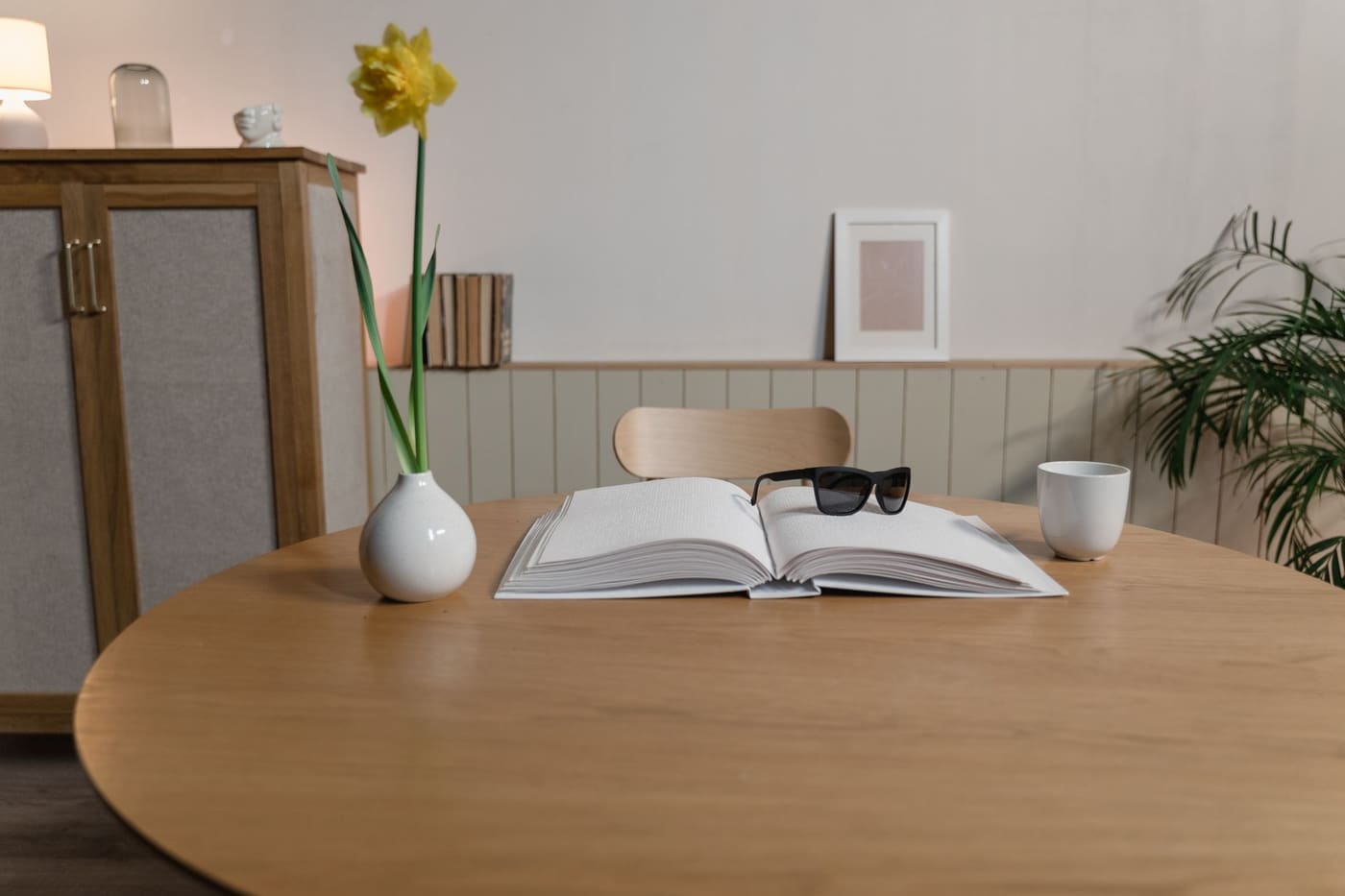
A room feels finished, not cluttered, when each decorative item has a reason to be there, objects are grouped instead of scattered, and some surfaces and wall space are deliberately left empty. Add the final layer in this order: textiles, art, plants, then small objects. Then edit back by removing roughly a third of what you first put out.
The gap between “bare” and “busy” is narrow, and most people overshoot it because the last stage of decorating involves lots of small purchases. The sections below give you a sequence, some measurements, and a few editing rules so the finishing layer adds warmth without adding noise.
Finish in layers, in a fixed order
Work from largest to smallest so the big decisions set the frame for the small ones.
- Furniture and rug first. If the layout is still shifting, decor has nothing to anchor to. The room layout guide helps settle that before you accessorize.
- Window treatments and lighting. Curtains, shades, and lamps change the feel more than any shelf object does.
- Textiles. Pillows, throws, and bedding bring color and texture.
- Art and mirrors. These fill the walls and set the focus.
- Plants and greenery. They soften edges and add height.
- Small objects. Books, candles, bowls, and trays go last.
Stopping after step 3 or 4 and living with the room for a week is a useful habit. A room that feels slightly under-decorated often just needs one or two more pieces, while a room that feels busy needs things taken away.
Limit the number of competing elements
Clutter is mostly about too many unrelated things at similar visual weight. Rooms feel calmer when the eye has a clear order: one dominant element, a few supporting ones, and quiet background.
A workable limit per room is:
- One focal point, such as a fireplace, a large piece of art, or a statement lamp
- Two or three supporting accents, such as a pair of pillows, a plant, or a bench
- Quiet fillers, such as plain walls, simple curtains, and neutral rugs
If every surface has a statement piece, nothing reads as important. Pick which item should win attention and let the rest support it. Repeating a color or material at least three times in a room (for example, a black frame, a black lamp base, and black hardware) also helps unrelated objects look connected. The article on using color and materials so a room feels cohesive explains how to choose those repeats.
Group objects in odd numbers and cluster them
Scattered single objects look like clutter even when the total count is small. Grouping them creates one visual unit, which counts as one thing to the eye instead of five.
Useful grouping rules:
- Use threes and fives. Odd-numbered groups tend to look more natural than pairs, though a symmetrical pair works on a formal mantel or flanking a bed.
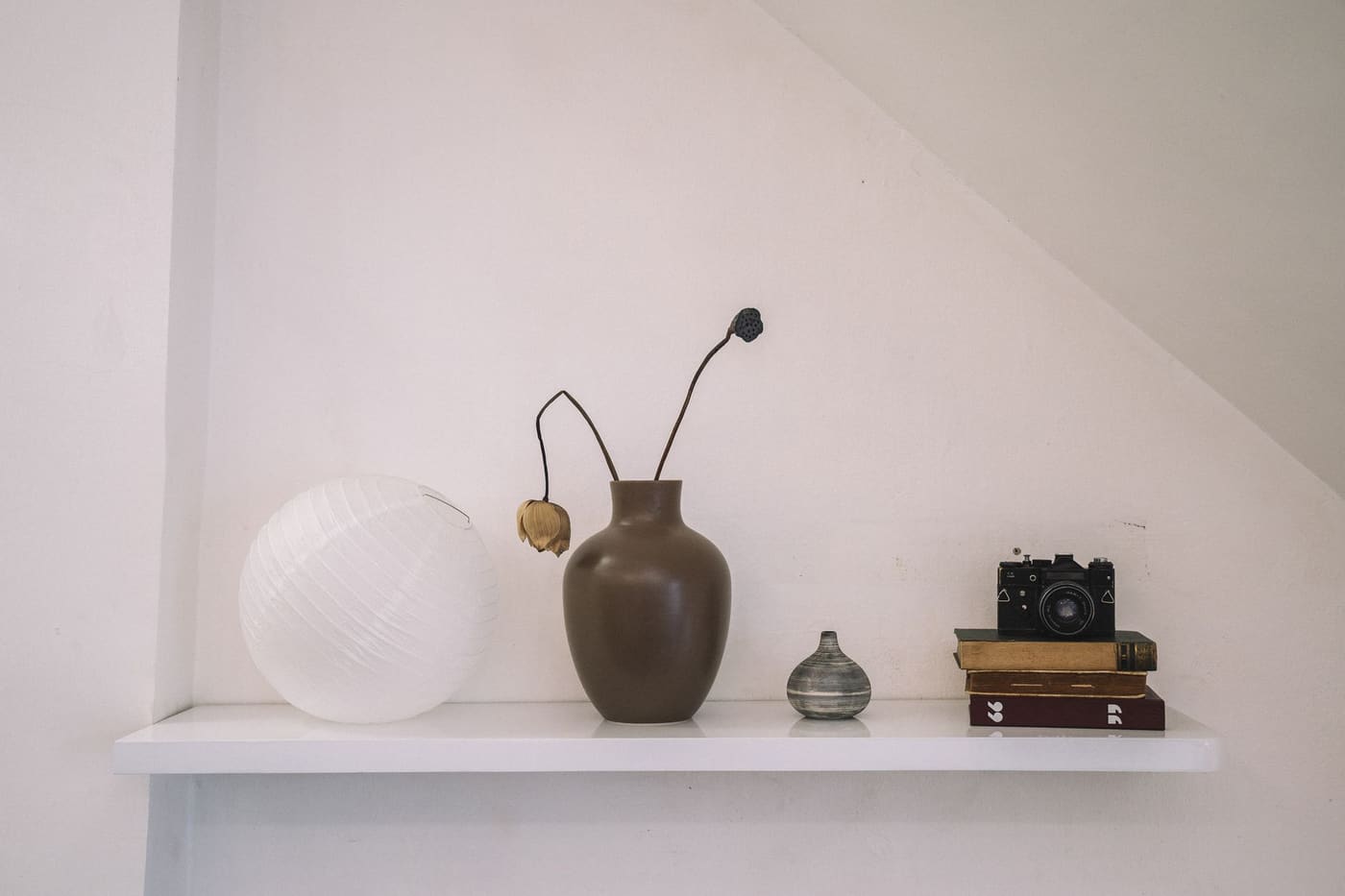
- Vary height. In a group of three, use a tall item, a medium one, and a low one, such as a vase, a stack of books, and a small bowl.
- Use a tray. A tray on a coffee table or dresser corrals small items, such as candles and remotes, so they read as one arrangement. A tray roughly 12 by 18 inches is a common size.
- Leave negative space. Keep a few inches between groups, and leave at least a third of a shelf or tabletop empty.
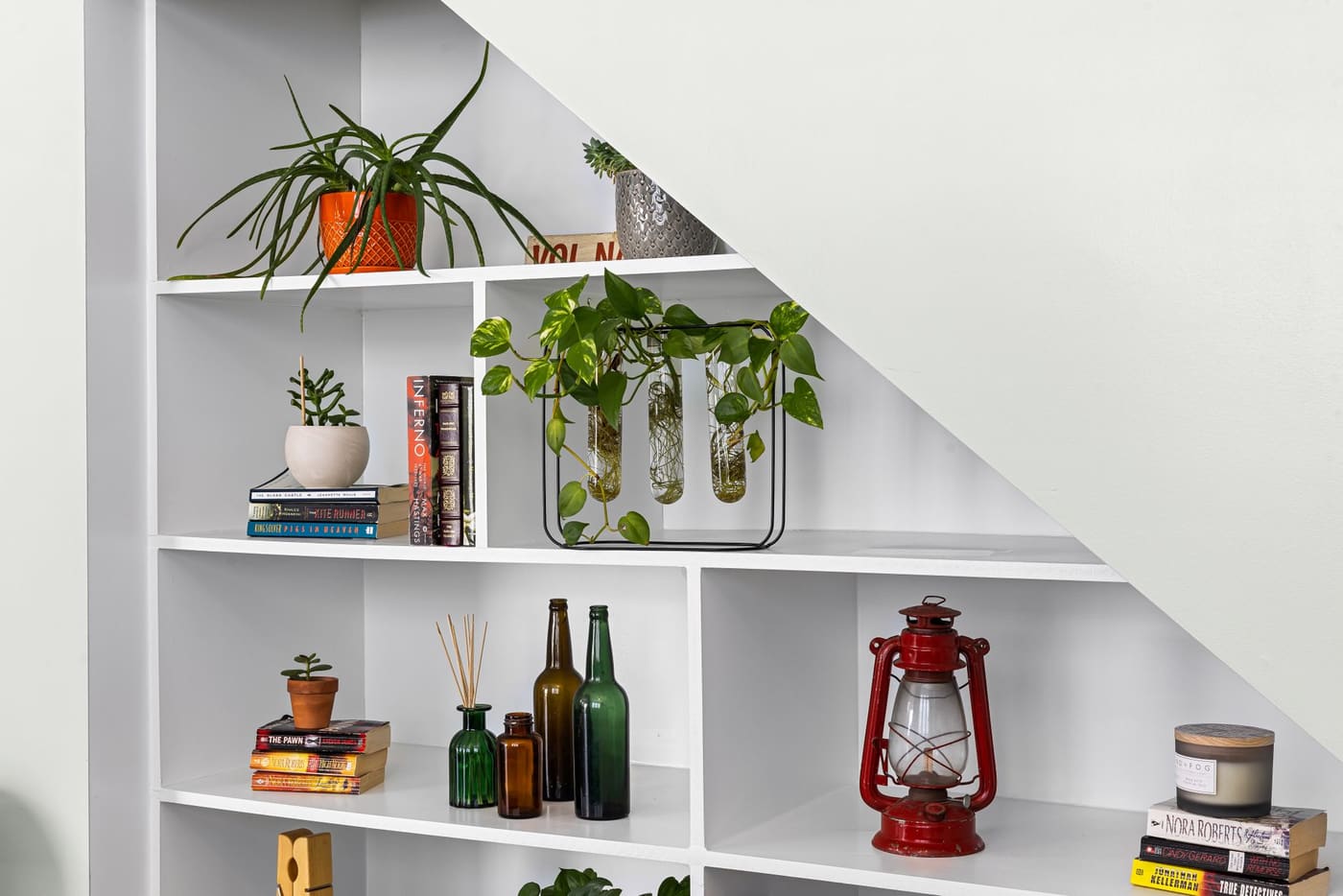
On open shelves, a common approach is to alternate: a section of books, a gap, a section with one or two objects, a gap. Avoid filling every shelf edge to edge, since that tends to look like storage and not display.
Hang art at the right height and scale
Art hung too high or too small is one of the most common reasons a wall looks unfinished. A widely used gallery guideline is to center art at about 57 inches (145 cm) from the floor, roughly average eye level, and many designers allow up to 60 inches. Over a sofa or console, hang the bottom edge about 6 to 10 inches above the furniture, and make the art, or a group, about two-thirds to three-quarters the width of the piece below it.
For gallery walls, lay everything out on the floor first or trace the frames onto kraft paper and tape the paper to the wall. Keep gaps of about 2 to 3 inches between frames, and use two or three frame colors at most. Matching mats help varied art feel related.
Hanging weight matters for safety. Use anchors rated for the weight of heavy mirrors and large frames, and find studs when you can. Heavy mirrors over a bed or a sofa should be mounted to studs or with properly rated hardware. If you are unsure what your wall is made of, check before drilling, and call a handyperson for large pieces. Drilling near electrical wiring or pipes can cause real damage, so avoid areas directly above outlets and switches.
Use textiles to add softness without busyness
Pillows, throws, and curtains are the easiest way to add color and texture, and the easiest to overdo. On a standard sofa, three to five pillows usually looks full without taking over the seat. Use a mix of sizes, such as two 20-inch squares and one lumbar, and vary pattern scale: one larger pattern, one small, and one solid.
Stick to a palette of two or three colors across textiles. A throw folded over one arm of the sofa is enough, since stacking blankets on every chair adds visual noise. For curtains, hang the rod close to the ceiling or 4 to 6 inches above the window frame and let the panels reach the floor. That adds height to the room, which most people find calmer than short curtains that stop at the sill. Textiles should also earn their place in comfort, so avoid pillows nobody uses or throws that never get touched.
Edit before you add more
The most reliable finishing step is subtraction. After styling a room, do an edit pass:
- Take a photo of the room. A photo flattens the space and makes clutter easier to see.
- Remove one item from every cluster, then see whether you miss it.
- Clear every flat surface that is not used daily, and put back only what has a reason to be there.
- Move duplicates to another room. Three candles and two bowls on one table is usually one candle and one bowl too many.
- Store out-of-season items. Rotating decor seasonally keeps surfaces fresh without constant purchasing.
Functional clutter, such as keys, mail, chargers, and remotes, is a bigger source of visual mess than decor. Give each a home: a dish or hook by the door, a basket for remotes, a cord box for chargers. Closed storage, such as cabinets, lidded boxes, and baskets with lids, hides necessary items better than open shelving does.
Check scale and balance
Even well-chosen items can look wrong in the wrong size. Tiny objects on a large surface look lost, and oversized objects in a tight spot look crowded.
A few checks:
| Place | Size guideline |
|---|---|
| Large wall over a sofa | One big piece or a grouped set about two-thirds the sofa width |
| Coffee table | Occupy no more than about a third of the surface |
| Mantel | Odd number of items, varying heights, leave gaps |
| Entry console | One lamp or mirror, a tray, and one object |
| Floor | Keep one open path, with a plant or basket in a corner only |
Balance does not require symmetry. If one side of a wall holds a tall bookcase, balance it with a floor lamp and a framed piece on the other side.
For furniture issues that undermine the finishing layer, such as pieces that are too big for the space, see the guidance on choosing furniture that fits a room properly. Lighting also affects how styled a room looks, and the article on lighting that makes a room feel better and more usable covers lamps and bulbs.
To work through the finishing steps in order, use the room finishing checklist.
Where this comes from
The sizes, clearances and ratios here are common interior-design rules of thumb published by design and furniture publications, not building codes, and they are guidelines to adjust to your room. Prices, product specifications and local rules change, so check current figures with the seller, manufacturer or local authority before you buy or start work. It is based on common interior-design styling guidance, including the gallery-hanging convention of centering art near eye level.